
Tardigrades
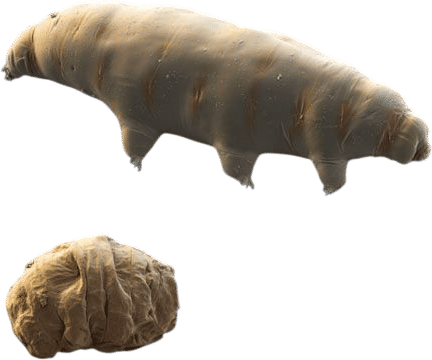
(cover photo from Eye of Science/ Photo Researchers via American Scientist)
Okay sweeties this one took me approximately one million years because my illness is flaring and there is SO much information, but you better believe I’ve been learning about tardigrades. Featured creature from @jmd, who also sent the fantastic Ologies ep on tardigradology. In the episode, Alie Ward talks to this very charming tardigradologist named Dr. Paul Bartels. I read like four other articles, but I am gonna be referring to the episode/ my new friend Dr. Paul a lot (side note: this one's so long; I'm sorry).
So basically, these guys are tiny multicellular invertebrates who kinda mind their own business. Tardigradia is an entire phylum (within Animalia) that contains many, many species (Paul says about 1400) with a lot of variation. Paul says the largest tardigrades get up to 1mm (he calls them Tardigrades of Unusual Size, or TOUS’s), but they are generally smaller. William Randolph Miller, writing for American Scientist, says the average is ~ half a millimeter, “about the size of the period at the end of this sentence.” Their name means “slow stepper” or “slow walker,” because unlike most of what you see under a microscope, they just kinda lumber around. There are saltwater and freshwater tardigrades, as well as terrestrial tardigrades, which Miller calls “limnoterrestrial,” in that they live in the very small amount of water in places like mosses or lichens. They’re also super old! An article from University of Wisconsin Madison by Thea Whitman says that tardigrades “date their existence on Earth to more than 500 million years ago.” What is it with me and living fossils? Here’s a diagram of a “generic water bear,” also from American Scientist:
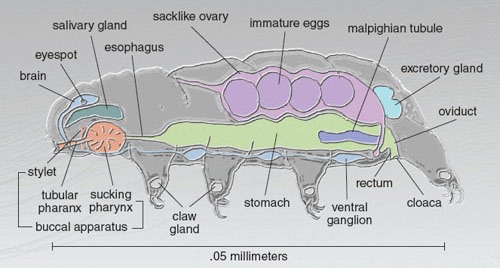
(Illustration by Tom Dunne, adapted from a figure by William Randolph Miller)
As you can see, they have pretty complex bodies, with a “complete digestive system” and a “well-developed nervous system,” according to a paper from 2016 by Edmann Weronika and Kaczmarek Lukasz. They have pretty short lives (Weronika and Lukasz write that their life span is “two to several months”), but that comes with a pretty big caveat:
Basically, terrestrial tardigrades can enter something called cryptobiosis, because their habitats are quite unstable. In the diagram below, Miller breaks down tardigrades’ various survival mechanisms for American Scientist. The bottom three states are all types of cryptobiosis, in which the tardigrade retracts into a little shape called a tun and suspends its metabolism. Kind of like super-hibernation, to my unscientific mind. Of anhydrobiosis (desiccation), Miller writes, “It is almost as if the animal preserves itself by becoming a powder comprised of the ingredients of life.”
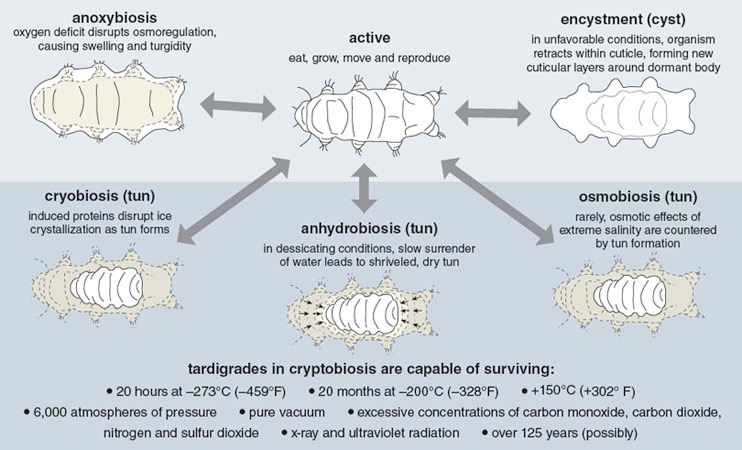
(Illustration by Tom Dunne. Note, the American Scientist article is from 2011, so I think some of this information may be out of date -- the Ologies ep is definitely my most recent source)
As the diagram notes, tardigrades can survive some pretty shocking stuff in cryptobiosis. They are often categorized as extremophiles (most of the articles I read used that term), but Dr. Paul argues that they’re actually “extremotolerant,” since they’re “pretty easy to kill” out of cryptobiosis. But their ability to survive these extremes without permanent damage is pretty revealing, and scientists have discovered “unique proteins that keep its cells safe, reduce stress from lack of oxygen and protect their DNA from damage,” according to Rob Parton, a professor interviewed by the University of Queensland (the article is called “‘Just add water’ – the magic of tardigrades,” which I thought was fun bc people on here keep sharing that {very wise} quote from @joanna goddard). Here’s a video from the University of Queensland of a tardigrade coming out of cryptobiosis:
(Video footage from Dr. Tom Hall)
Most famously, in 2007 and 2011, tardigrades went to space! The article I mentioned by Weronika and Lukasz is called “Tardigrades in Space Research – Past and Future,” though it’s also out of date by now (published in 2016). In the Ologies ep, Dr. Paul notes that sometimes their space survival abilities get exaggerated – he says the “fine print” is that they were only exposed to “some aspects of space,” not “total exposure.” According to Paul, the active ones “survived really, really well” when exposed to “the microgravity and the cosmic radiation of space,” and ones in cryptobiosis even survived the vacuum of space (but not full solar radiation). But having multicellular organisms that can survive elements of space travel is pretty exciting for space research, and Weronika and Lukasz write that some scientists have used them to try to prove the very controversial theory of panspermia (more here, but basically panspermia is the theory that life on earth originated elsewhere.)
Metaphor Corner:
At one point in the Ologies ep, Alie asks a question from a listener that boils down to “are tardigrades aliens?”, which Dr. Paul pretty firmly shuts down (and this is when he mentions how controversial panspermia is, and this one experiment where they shot tardigrades out of a gun). Paul ventures that they seem alien because “people don’t pay attention to the microscopic world.” I thought this was pretty interesting, because I’m often thinking about the deep space/deep ocean connection – we have these places on our planet that are so mysterious and unreachable and unsurviveable to us (and, not to GO OFF, but that’s also how I think about the mystery that is the human brain). And it occurred to me that the microscopic world is another alien/not alien space, right next to us but outside of most of our grasps. And it’s kind of magical to me that there are these bonkers creatures in our world that we don’t even think about, just trundling along in our backyards, slow-stepping under our feet.
a month ago
Comments
More like this




Follow Lida Richardson
By submitting, you agree to our Terms and Privacy Policy